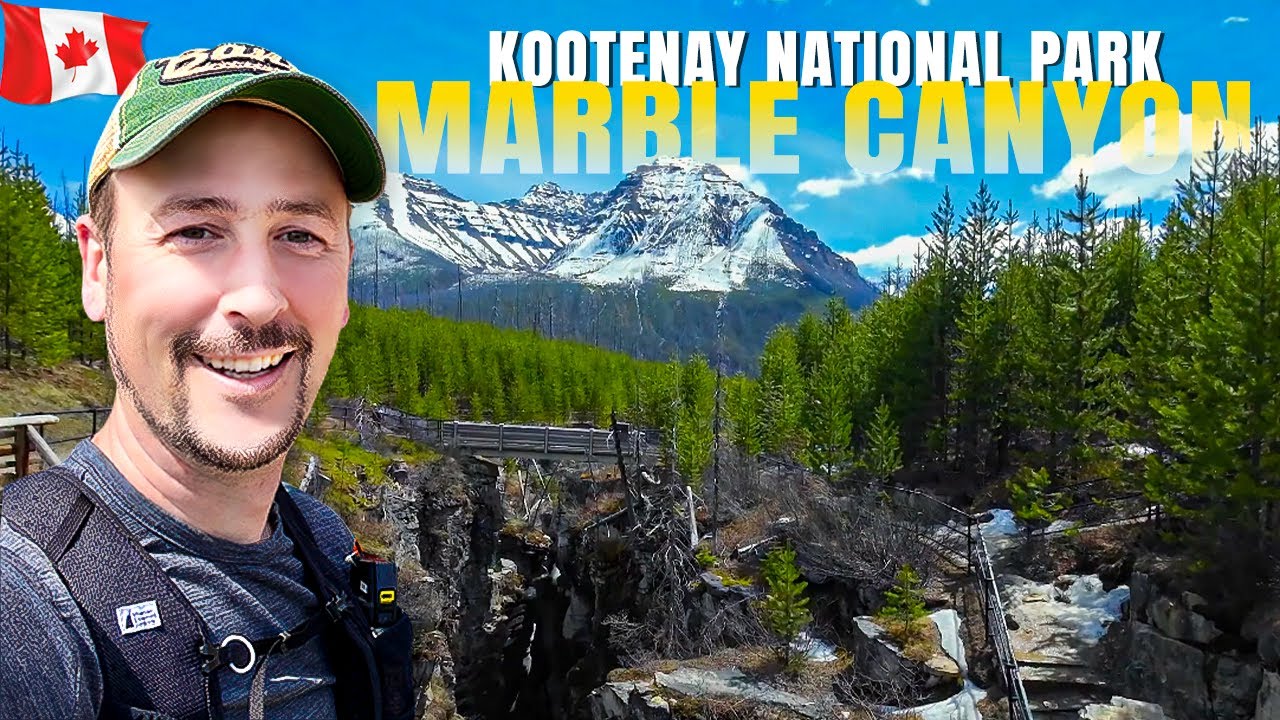
In this video, I’m taking you to one of the most rewarding experiences in Kootenay National Park: a comprehensive review of Marble Canyon Campground paired with a complete walkthrough of the self-guided interpretive trail through Marble Canyon itself. This two-for-one experience showcases both where to stay and what to explore in the northern reaches of this spectacular Canadian Rockies park.
Marble Canyon represents one of those rare destinations where exceptional camping and world-class natural features converge in a single location. The campground serves as an ideal base camp for exploring the extensive mountain trail system in northern Kootenay National Park, while the canyon itself offers a geological wonder that ranks among the park’s must-see attractions. Whether you’re planning a campground review research trip or simply looking for your next mountain adventure, this location delivers on multiple fronts.
In my video below, I walk through the experience exactly as shown and explained:
Marble Canyon Campground: Your Northern Kootenay Base Camp
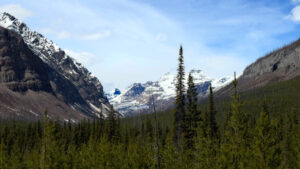
Marble Canyon Campground operates from late June to early September, positioned high in a sub-alpine spruce forest that offers spectacular mountain views in every direction. This seasonal window captures the prime summer months when the northern reaches of Kootenay National Park are most accessible and the weather conditions ideal for exploring the surrounding trail network.
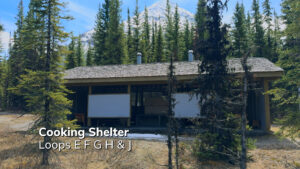
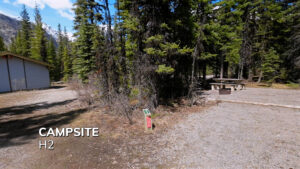
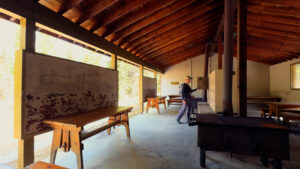
The campground features sixty campsites spread throughout the spruce forest setting. What I appreciate about this facility is the comprehensive range of services it provides despite its sub-alpine location. You’ll find drinking water available throughout the campground, flush toilets for comfort and convenience, and a sani-dump station for those traveling with larger vehicles. Each campsite comes equipped with a fire pit, and the campground includes cooking shelters that prove invaluable during inclement weather. Food lockers are provided at each site, an essential feature in bear country that allows you to store your provisions safely while enjoying the wilderness experience.
It’s important to note that all sites at Marble Canyon Campground are unserviced. This means no electrical, water, or sewer hookups at individual sites. The campground design reflects this reality, with sites best suited for tenting and smaller recreational vehicles. If you’re traveling with a motorhome or trailer, keep in mind that the campground accommodates vehicles under fifteen feet in length. This size restriction isn’t arbitrary—it reflects both the forest setting and the access roads leading into the campground area.
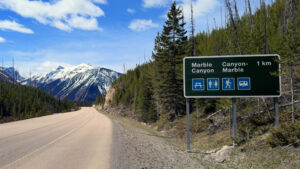
Strategic Location in Northern Kootenay
The campground’s position in the northern section of Kootenay National Park makes it an excellent staging point for multiple adventures. Beyond serving as your overnight base, the location provides easy access to the self-guided interpretive trails that have made this area famous. The Marble Canyon trail itself begins practically at your doorstep, while the culturally significant Paint Pots site is also readily accessible from the campground. This clustering of attractions means you can experience some of Kootenay’s best features without lengthy drives each morning.
The sub-alpine spruce forest environment creates its own atmosphere. The elevation brings cooler temperatures even in summer, and the forest canopy provides natural shade throughout most campsites. The mountain views that frame the campground remind you constantly that you’re deep in the heart of the Canadian Rockies, in British Columbia’s contribution to this extraordinary mountain landscape.
The Marble Canyon Trail Experience
The self-guided interpretive trail through Marble Canyon itself represents a geological showcase that ranks as a must-see feature in Kootenay National Park. This isn’t hyperbole—the canyon’s formation and accessibility combine to create something truly special among the park’s many attractions.
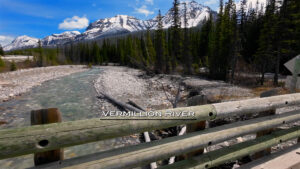
Marble Canyon sits just above Tokumm Creek and its confluence with the Vermilion River. This location at the north end of Kootenay National Park places it in a transitional zone where waterways converge and geological forces have carved something remarkable into the landscape. The Tokumm Creek doesn’t simply meet the Vermillion River—it joins it through a magnificent gorge that geologists classify as a box canyon.
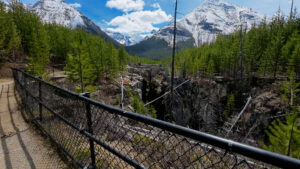
A Geological Wonder Carved in Stone
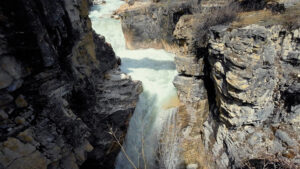
What makes this canyon extraordinary is its narrowness. Walking the trail, you’ll encounter sections where the gorge becomes so constricted that it appears less like a canyon and more like a crack or fissure in the rock strata. The walls rise vertically on either side of the churning water below, and in several places the gap has become so narrow that massive boulders have wedged themselves across the opening, creating natural bridges spanning the chasm.
These wedged boulders add to the dramatic nature of the canyon experience. They’re not small stones—these are huge rocks that have somehow become jammed across the narrowest sections of the gorge. Standing on the trail bridges and viewing platforms, you can see these geological time capsules suspended above the creek, testament to the power of the forces that shaped this landscape.
The self-guided nature of the trail means you can move at your own pace, stopping at each viewpoint to absorb the scale and intricacy of what water has carved through solid rock. The interpretive elements along the trail provide context for what you’re seeing, explaining the geological processes and the timeline involved in creating this natural feature.
A World-Class Fossil Discovery Site
Beyond its visual impact, Marble Canyon gained international scientific attention in early 2014 when researchers announced a major new discovery of fossilized Cambrian soft-bodied organisms in or near the canyon area. This finding isn’t just locally significant—it rivals or even surpasses the nearby Burgess Shale fossil site in both size and preservation quality.
The Burgess Shale is itself world-renowned among paleontologists, so for Marble Canyon to be compared favorably to it speaks volumes about the importance of this discovery. The initial excavation revealed that twenty-two percent of the observed species were entirely new to science. That’s a remarkable percentage from a single site, representing organisms that had never been documented or described before.
Adding to the scientific excitement, researchers also found several species at Marble Canyon that were previously known only from Chinese Lagerstätten—fossil beds created millions of years earlier. Finding these species at Marble Canyon helps scientists understand the distribution and evolution of these ancient life forms across different continents and time periods.
To protect this invaluable scientific resource, the exact location of the fossil site remains confidential. This decision prevents damage from well-meaning but potentially destructive visitors and ensures that paleontologists can continue their work without interference. While hiking the canyon trail, you’re walking through an area that’s rewriting our understanding of Cambrian life, even if the precise excavation site isn’t marked for public viewing.
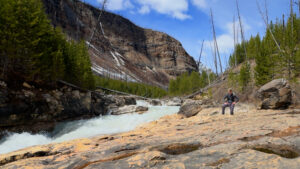
The Confluence of Waters
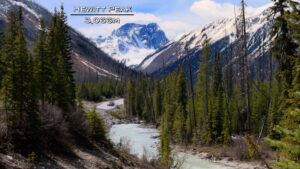
The meeting point of Tokumm Creek and the Vermilion River adds another layer of interest to the Marble Canyon area. These waterways carry snowmelt and glacial runoff from the surrounding peaks, and their confluence represents the joining of different watershed systems. The Vermilion River is one of Kootenay National Park’s major waterways, and seeing where Tokumm Creek contributes its flow through the dramatic canyon gorge helps you understand how these mountain water systems interconnect.
The force of water moving through such a narrow channel creates constant sound and motion. Even during lower water periods, the constricted canyon amplifies every movement of the creek, creating an acoustic experience that accompanies the visual spectacle. During peak runoff periods in early summer, the power of water moving through these narrow passages becomes even more evident.
Planning Your Visit
The seasonal operating window for Marble Canyon Campground from late June to early September corresponds with the period when the northern section of Kootenay National Park is fully accessible and conditions are optimal for day hikes and exploration. Early in the season, you might encounter lingering snow on higher elevation trails, while later in the window brings the possibility of early fall weather.
Booking a site at this popular campground requires advance planning. The combination of limited sites, excellent facilities, and proximity to major attractions means that Marble Canyon Campground fills quickly during peak summer weeks. The sixty sites go fast, particularly during July and August when families and outdoor enthusiasts from across North America converge on the Canadian Rockies.
If you’re arriving with a tent, you’ll find the campground ideally suited to your needs. The forest setting provides natural privacy between sites, and the amenities support comfortable tent backpacking-style camping without sacrificing access to flush toilets and other conveniences. For those with small motorhomes or trailers under fifteen feet, the campground can accommodate your vehicle, but be mindful of the size restrictions and the unserviced nature of all sites.
Exploring Beyond Marble Canyon
While the canyon trail itself is the headline attraction, the campground’s location provides access to the broader trail network in northern Kootenay National Park. The Paint Pots site, with its culturally and historically significant ochre beds, makes an excellent companion trip to your canyon visit. The northern section of the park features numerous other hiking opportunities ranging from short interpretive walks to more challenging mountain ascents.
The Vermilion River corridor, which runs near the campground, offers its own exploration possibilities. The river valley creates a natural transportation route through the mountains, and following its course reveals different perspectives on the surrounding peaks and forests. Whether you’re interested in sightseeing drives or more ambitious hiking objectives, the Marble Canyon area serves as an effective base.
The Canadian Rockies Experience
Camping at Marble Canyon places you firmly within the Canadian Rockies experience. This isn’t a gentle foothills environment—you’re in the main ranges, surrounded by substantial peaks and immersed in true mountain ecosystems. The sub-alpine spruce forest represents a specific elevation band where trees thin out and alpine conditions begin to assert themselves. The wildlife, the weather patterns, and the overall environment all reflect this high-mountain setting.
British Columbia’s portion of the Canadian Rockies sometimes receives less attention than the Alberta side, but Kootenay National Park demonstrates that spectacular scenery knows no provincial boundaries. The park protects a significant corridor of Rocky Mountain wilderness, and Marble Canyon represents one of its most accessible and rewarding features.
Following the Journey
Since 2020, I’ve been exploring the Canadian Rockies and sharing these experiences through my videos. The goal is to provide practical information and genuine perspectives on what these places offer. Whether you’re researching things to do in Jasper National Park, searching for hikes in Banff National Park, or looking for accommodations across the mountain parks, the content aims to support your trip planning with real-world details.
From iconic destinations like Maligne Lake, Spirit Island, and Athabasca Falls in Jasper, to Johnston Canyon, Lake Louise, and Moraine Lake in Banff, to Natural Bridge, Takakkaw Falls, and Emerald Lake in Yoho National Park, the Canadian Rockies offer an incredible diversity of experiences. Trail systems like the Valley of the Five Lakes, the Icefields Parkway, the Skyline trail, Tunnel Mountain, Sentinel Pass, Bow Glacier falls, the Lake O’Hara Alpine circuit, the Iceline trail, and the Hamilton Lake trail provide options ranging from casual walks to serious mountain adventures.
Understanding where to stay—whether in campgrounds, cabins, or hotels—forms a crucial part of trip planning. The videos provide reviews and information about these accommodation options across Jasper, Banff, and Yoho, helping you make informed decisions about your base camps. The content aims to give you the practical details and visual previews that make planning easier and more effective.
For those seeking camping reservations in competitive parks like these, timing and persistence matter. Services like Campnab can help by scanning for camping cancellations, potentially opening up opportunities at popular campgrounds that appeared fully booked. You can check out their service at https://campnab.com/r/s5nrrv.
The gear used during these adventures is detailed at www.EricTremblayAdventures.com/Gear, providing transparency about equipment choices and performance in real mountain conditions. For those who appreciate geographic context, video maps showing exact locations and routes are available at www.EricTremblayAdventures.com/map.

Road Trips Through Mountain Corridors
The road trip aspect of exploring the Canadian Rockies shouldn’t be overlooked. Highway corridors like the route through Kootenay connect different regions and provide their own scenic experiences between destinations. The drive to Marble Canyon takes you through elevation changes and ecosystem transitions, with viewpoints and pullouts revealing different aspects of the mountain landscape.
Travel guides for Alberta Parks and BC Parks help organize information across regions, making it easier to plan multi-day or multi-week itineraries that sample different areas. The Canadian Rockies span a large area with distinct sections, each offering unique character and attractions. Understanding how these pieces fit together helps you maximize your time and experiences.
Marble Canyon Campground and the canyon trail represent the kind of concentrated excellence that makes certain locations stand out. Having both a quality campground and a world-class natural feature in one place creates efficiency and value for visitors. You’re not just passing through to see one thing—you’re establishing a base in a location where multiple experiences converge.
The combination of accessible trails, fascinating geology, significant paleontology, quality camping facilities, and genuine mountain atmosphere makes Marble Canyon worthy of consideration for anyone planning a Kootenay National Park visit. Whether you’re tenting in the spruce forest or exploring the narrow gorge carved by Tokumm Creek, you’re experiencing some of the best that this section of the Canadian Rockies has to offer.